






Learn how to pick the right wall for a feature wall, choose a color and undertone that work with the room, and select a sheen. Also covers prep, crisp edges and how much paint to buy.
For feature wall painting, pick the wall your eye lands on first, usually the one opposite the entrance or behind the bed, sofa or fireplace. Choose a color a few shades lighter or darker than the other walls, with the same undertone. Use eggshell or matte, and expect a bold color to need primer.
Which wall should be the feature wall?
Start with the wall you see when you walk in. Sherwin-Williams says the wall that comes into view opposite the main entrance is in most cases the one selected as the feature wall.
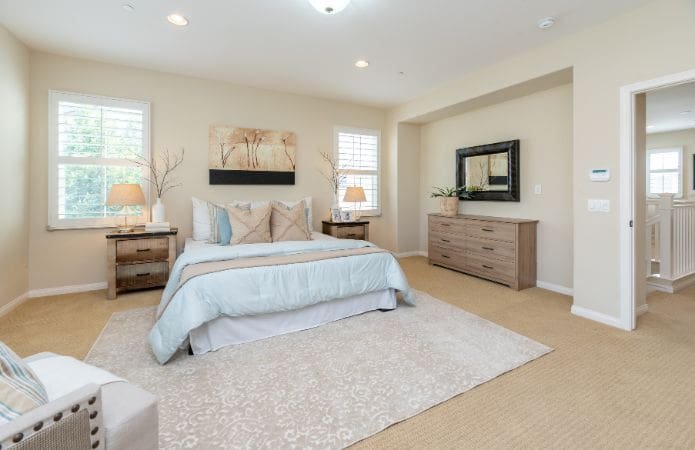
In bedrooms and living rooms, the focal point may be elsewhere. This Old House lists fireplaces, the headboard of a bed, and the TV wall in a living room as common focal points, and says it's often best to emphasize the natural one.
If you are torn between two walls, score each one with a point for each of these: it is the first thing you see, it has an inside corner on both sides, it is symmetrical, and the furniture already centers on it. The wall with the most points wins.
Which walls should you avoid?
Skip walls broken up by several doors and windows, because the color gets chopped into patches and loses its punch. Skip any wall that competes with another focal point. Benjamin Moore advises making sure the accent wall isn't competing with anything else in the room.
Corners matter too. Starting and stopping colors on an inside corner always looks better than on an outside corner, so prioritize walls with inside corners on both sides. If no wall qualifies, the ceiling can serve as a "fifth wall."
How do you choose the accent color?
Look at what is already in the room. Sherwin-Williams suggests choosing a color a few shades darker than the other walls. A paint chip strip helps, since it shows three to six shades in one color family. You can also pull a color from a pillow, throw or drapes.
Keep the undertone consistent. Farrow & Ball's Patrick advises avoiding really strong contrasts with the adjacent walls and looking for colors with the same undertone for a more blended look.
Don't pick neighbors on the chip strip. Many people choose colors immediately next to each other on the card, only to find the difference is indiscernible on the wall. Go one or two colors down for a subtle look.
Should the color be subtle or bold?
Balance the room. Benjamin Moore says that for rooms with darker walls, consider a lighter accent. If the walls are light and airy, consider a deeper, bolder color. A neutral room can take navy, red, turquoise or black.
Temperature also matters. Cooler colors tend to recede and make a space feel open, while a warm accent wall can feel smaller and cozier. A warm color on a short wall in a small room will feel close. Use that on purpose, such as behind a bed, or avoid it in a narrow room.
How do natural light and bulbs change the color?
Room direction and bulb type shift how a color reads. Benjamin Moore says to consider the direction your room faces and the natural light it gets. Warm bulbs push a color toward yellow and red. Cool bulbs push it toward blue and make it look flatter.
Test in the room itself, not at the store:
- Paint a large sample on the feature wall and another on a different wall, so you see it in both light conditions.
- Look at it in the morning, in the afternoon and in the evening with your lamps on.
- Check it next to your sofa, curtains or floor.
Leave samples up for a couple of days. A color that looks right in all three checks is safe to buy. The same testing habit helps outdoors too, as in this guide to fence painting in Brentwood.
Which sheen suits a feature wall?
Eggshell or matte suit most feature walls. Use more sheen only on a smooth wall that needs scrubbing. Benjamin Moore explains that sheen is a measure of how much light reflects off a painted surface, and that it can change how colors appear.
| Sheen | Look | Flaw hiding | Cleanability | Best feature-wall use |
|---|---|---|---|---|
| Matte | Very little shine, deep color | Very forgiving | Lower; stains are harder to remove | Bedrooms, dining rooms |
| Eggshell | Soft glow | Good | Moderate | Living rooms, most feature walls |
| Satin | Smooth sheen | Fair | Good | Hallways, kids' rooms |
| Semi-gloss | Noticeable shine | Poor; shows blemishes | Best | Smooth walls needing frequent wiping |
Benjamin Moore says matte finish offers excellent hide and depth of color with slightly more durability than flat, and suits bedrooms and dining rooms. It also cautions that stains are harder to remove from low-sheen paint in high-traffic areas. A gloss finish accentuates blemishes, so avoid it on walls that are not completely smooth.
How do you prep the wall and get crisp edges?
Clean, patch, sand and spot-prime first, because a feature wall draws the eye and shows every flaw. Wipe off dust and grease, fill nail holes and dents, sand the patches smooth, and prime the repairs so they don't show as dull spots. Our wall prep checklist walks through each step.
Next, press the tape down firmly along the ceiling line and the adjacent walls. Run a putty knife along the tape to seal the edge so paint can't creep under it. Many painters brush a thin coat of the existing wall color over the edge first, so any bleed matches the neighboring wall. Then paint the accent color.
Paint right up to an inside corner so the color changes where the walls meet. Pull the tape while the last coat is still slightly wet, at a low angle, away from the fresh paint. If the paint has dried hard, score the edge with a blade first so it doesn't peel. For more on avoidable errors, see these common interior painting mistakes.
How much paint does one wall need, and do bold colors need primer?
One wall usually takes less than a gallon. Confirm on the can how much area a gallon covers. A quart is enough for that wall. Buy a gallon if the wall is large, you want a third coat, or you need extra for touch-ups.
Dark and bold colors often need more. Deep reds, navy and black are likely to need a tinted primer and an extra coat to cover evenly, especially over a light wall. Plan on three coats worth of paint, and buy a gallon.
If you'd rather have a crew handle the color choice, prep and crisp lines, see what PaintPro Tennessee offers.