





Find out whether your cabinets can take stain or need paint, how the two finishes compare on prep and drying, and what each typically costs for an average kitchen.
Stain your cabinets only if they are real wood or wood veneer and you want the grain to show at the same shade or darker. Choose paint if you want a solid or lighter color, or if your cabinets are painted, laminate or plastic-film. HomeGuide's 2026 data puts staining at $1,500–$4,500 and painting at $2,000–$6,500 for an average kitchen nationally.
Stain or paint: which fits your kitchen
Stain lets small nicks blend into the grain, and a scratch is simple to fix. Paint is a solid color, so a chip stands out and needs a matched touch-up.
| Factor | Regular stain | Gel stain | Paint |
|---|---|---|---|
| Surfaces | Bare real wood or veneer only | Real wood or veneer, not painted cabinets | Wood, laminate and other surfaces, with a bonding primer |
| Color change | Same or darker; strip to go lighter | Same color or darker | Any color, including lighter |
| Grain | Shows the most | Shows | Hidden |
| Prep | Strip or sand to bare wood | Degrease, then scuff-sand with 220- to 320-grit | Sand, prime, then sand again |
| Drying | Clear topcoat in thin coats; 24 hours between polyurethane coats | About six days before the topcoat, then three topcoats | At least 24 hours after primer |
If paint is where you're leaning, our 2026 kitchen cabinet colors with Sherwin-Williams codes post shows which shades suit busy kitchens.
What staining and painting cabinets cost
HomeGuide's per-square-foot rates nearly match: staining runs $4–$15 and painting $3–$15. Its typical painting totals still run higher than its staining totals ($2,000–$6,500 against $1,500–$4,500). Door count, wood type and how much prep the surface needs move the price most.
Take a kitchen with 300 square feet of cabinet surface, as an example. That sits inside HomeGuide's 250–400 square foot band for an average kitchen. Staining comes to $1,200 to $4,500 (300 × $4 to 300 × $15). Painting comes to $900 to $4,500 (300 × $3 to 300 × $15). That per-foot math gives a floor below HomeGuide's quoted totals for an average kitchen ($1,500–$4,500 staining, $2,000–$6,500 painting), and those totals are the better planning figure.
Painting quotes are often given per linear foot. The Spruce (2025) puts cabinet painting at $30 to $60 per linear foot nationally. On a kitchen with 30 linear feet of cabinets, that is $900 to $1,800. Our published Nashville figure for 2026 is $30 to $70 per linear foot, or $900 to $2,100 for the same kitchen. Treat that as a floor, not a quote. See our breakdown of cabinet painting costs for Nashville rental properties for how the local numbers work.
Can your cabinets take stain?
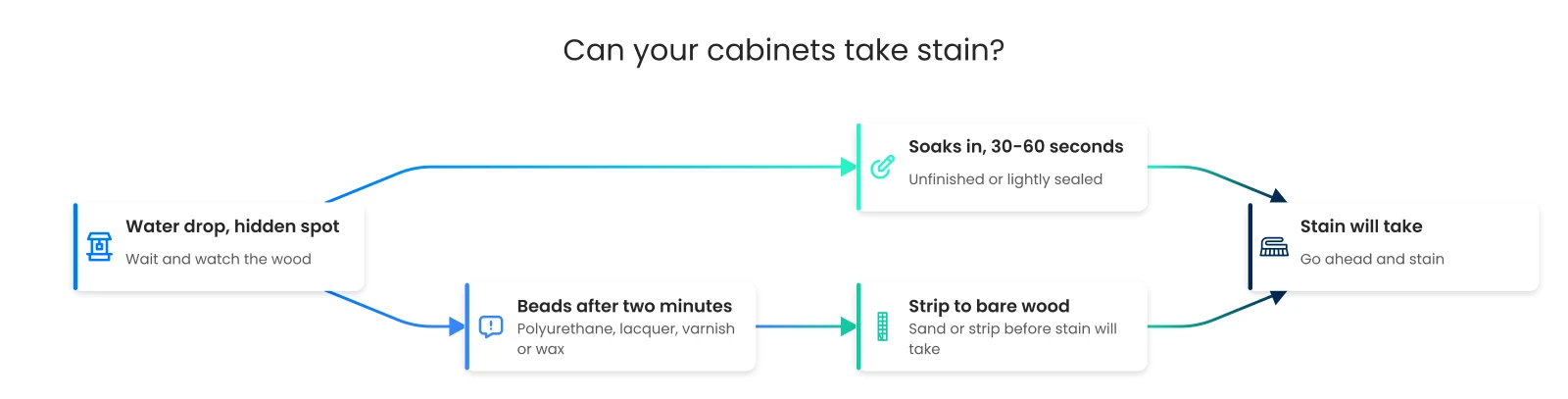
Place one drop of water somewhere out of sight. If it soaks in and darkens the wood within 30–60 seconds, the surface is unfinished or lightly sealed and will take stain. If it beads after two minutes, it is sealed with polyurethane, lacquer, varnish or wax. Then it has to be sanded or stripped to bare wood before stain will take.
Veneer is real wood sliced thin, and it can be as thin as 0.5–0.6 mm. The thinner it is, the less sanding it survives. Use 220 grit with a light touch, sand with the grain, and stay off edges and corners, where it burns through first.
Prep that changes the job
Whichever finish you pick, the doors come off and get labeled, and every surface gets degreased. Kitchen grease keeps stain from soaking in evenly.
- Stripping: gel stripper goes on a door or two at a time and sits about 10 minutes until it bubbles. Then you scrape with the grain and wipe off residue with mineral spirits.
- Sanding: on solid wood, start with 80 grit for rough spots and stubborn finish, and always sand with the grain. On veneer, skip the coarse grits and use 220 lightly.
- Test spot: try the color on a hidden spot first, and buy about 20% more stain than you expect to need so you never have to color-match a second batch mid-job.
Mistakes and safety problems to avoid
Strippers call for gloves and good ventilation. In a house built before 1978 with old paint on the cabinets, sanding can put lead dust in the air. Read the EPA's lead-safe renovation guide before you sand.
Stain is also a poor way to cover damage. Swollen or peeling doors need repair first, and our post on repairing kitchen cabinets before painting covers that work.
When paint beats stain on real wood
Even solid wood can be the wrong candidate. If the grain is badly blotched or patched, stain will look uneven. If the doors were painted before, stain won't work at all. A sanded, primed and sprayed paint finish hides those problems. If your cabinets fall in this group, we sand, prime and spray them.
Next step
If you're unsure which finish suits your cabinets, ask us for an on-site estimate, and we'll walk through your cabinets and talk through the options.
Related resources
- 2026 kitchen cabinet colors, with Sherwin-Williams codes
- Cabinet painting costs for Nashville rental properties
- How to repair kitchen cabinets before painting them
- Cabinet painters in Nashville, TN | Cabinet refinishing | PaintPro
Learn more about our cabinet painting and refinishing services.